
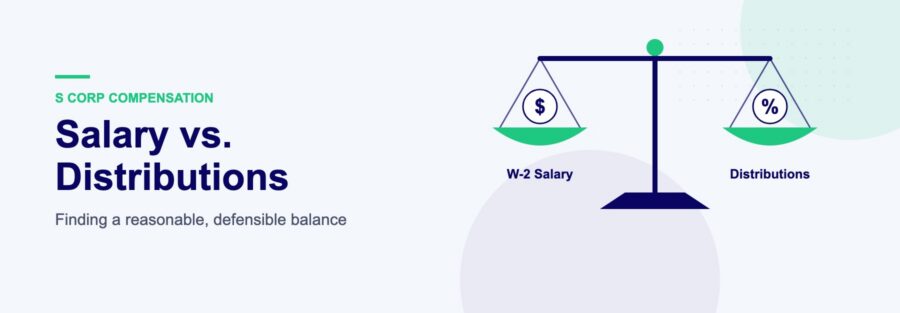
For many small-business owners, choosing an S corporation is an effective way to structure a business and manage taxes. But one area that deserves particular attention is shareholder-employee compensation—specifically, whether the owner is paying themselves a reasonable salary.
A common misconception is that an S corporation owner can simply take most of the company’s profits as distributions and pay themselves a very small salary—or no salary at all.
That approach can create significant tax problems.
In This Article
What Is a Reasonable Salary?
The IRS generally requires an S corporation shareholder who provides services to the corporation to receive reasonable compensation for those services before taking non-wage distributions.
There is no single IRS formula that determines what salary is reasonable.
Instead, compensation should be evaluated based on the facts and circumstances of the business and the services performed by the shareholder.
Factors that may be relevant include:
- The shareholder’s duties and responsibilities
- The shareholder’s experience and qualifications
- The amount of time devoted to the business
- The nature of the business
- The company’s size and profitability
- Compensation paid to other employees
- Compensation paid for similar positions in the same industry
- Geographic location
- Whether the shareholder is performing executive, professional, technical, sales, or administrative functions
In other words, the question is not simply “How much money did the business make?”
The more important question is:
“What would the business reasonably have to pay someone else to perform the services this shareholder is performing?”
Why Do S Corporation Owners Have This Issue?
S corporations generally have two common ways of putting money in the owner’s hands:
- Wages, reported through payroll and subject to applicable payroll taxes.
- Distributions, which generally are not subject to Social Security and Medicare taxes in the same manner as wages.
Because of this difference, some owners may be tempted to minimize wages and maximize distributions.
For example, suppose an owner actively operates a successful business that generates $200,000 of profit but pays themselves only $25,000 in wages while taking the remaining available funds as distributions.
The question becomes whether $25,000 is a reasonable salary for the services the owner actually performs.
If it is not, the IRS may challenge the compensation arrangement.
Low Salary Does Not Automatically Mean Tax Savings
Reducing salary may reduce payroll taxes in the short term, but aggressive compensation strategies can create other risks.
If the IRS determines that an S corporation shareholder should have received higher compensation, it may reclassify some distributions as wages.
That could result in additional:
- Federal employment taxes
- Income tax consequences
- Interest
- Penalties
The cost of an adjustment can therefore be substantially greater than the payroll tax the taxpayer originally attempted to avoid.
How Should a Business Owner Determine a Reasonable Salary?
There is no universal percentage—such as 30%, 40%, or 50% of company profits—that automatically produces a reasonable salary.
A better approach is to document the actual services performed and evaluate comparable compensation.
For example, if the shareholder is effectively functioning as the company’s president, salesperson, project manager, bookkeeper, and technical specialist, those responsibilities should be considered when evaluating compensation.
Useful supporting information may include:
- Industry salary surveys
- Job postings for comparable positions
- Compensation data
- Payroll records
- Employee responsibilities
- Hours worked
- Education and professional qualifications
- Geographic compensation differences
- The company’s organizational structure
The goal is not to find a number that produces the lowest tax.
The goal is to arrive at a defensible and commercially reasonable compensation amount.
What About a Business That Has Little or No Profit?
Reasonable compensation does not mean an S corporation must pay an arbitrary salary regardless of its financial circumstances.
A business experiencing losses or very limited revenue may require a different analysis from a highly profitable business.
However, an owner who is actively performing substantial services should not assume that a lack of cash automatically eliminates the compensation requirement.
This is one reason compensation should be reviewed based on the company’s actual facts rather than a predetermined formula.
Keep Good Records
One of the most important aspects of reasonable compensation is documentation.
Business owners should maintain records supporting their compensation decisions, particularly when compensation is significantly different from what might ordinarily be expected for the services performed.
A good file might include:
- A description of the owner’s duties
- Estimated hours worked
- Comparable salary information
- Industry compensation data
- Payroll records
- Company financial statements
- A written explanation of how compensation was determined
Good documentation does not guarantee that the IRS will agree with a particular salary, but it demonstrates that the business owner approached the issue thoughtfully rather than simply choosing an artificially low wage.
Don’t Wait Until Tax Season
Reasonable compensation should be considered throughout the year—not after the books are closed and the tax return is ready to file.
Changes in the business can affect an appropriate compensation level.
For example, if a business grows substantially, adds employees, expands into new markets, or the owner’s responsibilities increase, the compensation analysis may need to be revisited.
Likewise, a significant decline in business activity may require a fresh evaluation.
The Bottom Line
For S corporation owners, reasonable compensation is not simply a payroll decision—it is an important tax compliance issue.
Trying to minimize salary without considering the services actually performed by the shareholder can create unnecessary IRS exposure.
A better strategy is to establish compensation based on reasonable, supportable factors and maintain documentation explaining how the amount was determined.
Tax planning should reduce unnecessary taxes while keeping the taxpayer on solid compliance ground.
If you own an S corporation and are unsure whether your current salary is reasonable, a year-end compensation review can help identify potential issues before the tax return is filed. Contact Ultimate Tax & Accounting to review your S corporation payroll and compensation strategy.
This article is for general educational purposes only and does not constitute individualized tax, legal, or financial advice. Reasonable compensation depends on the specific facts and circumstances of each business.